
HOW MUSEBRIDGE WORKS ALONGSIDE MUSE
03 /
MAKE FACTS
FINDABLE.
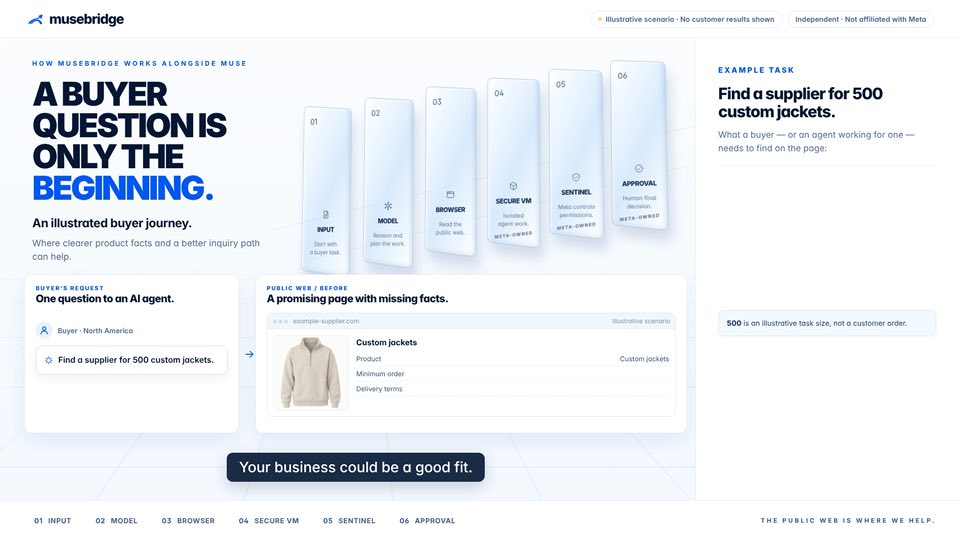
An illustrated buyer journey.
Explore where clearer product facts and better buyer paths can help. Select a layer to see the relevant MuseBridge tools.
Illustrative scenario · no customer results shown
THE WORKFLOW / IN MOTION
See the whole picture.
A short illustrated overview of buyer tasks, product evidence, and comparable tests. Then explore each tool below.
The video loads only when you press play.
Illustrative explainer · Not customer resultsOpen the video directly ↗MUSEBRIDGE / PROPOSED PRODUCT SYSTEM
Each tool has a specific job.
The modules below are a planned product framework. Select a card to see its input, intended output, and the value it is designed to create.
THE TECHNICAL BOUNDARY
Alongside Muse.
Outside its controls.
MuseBridge can structure a separate test, improve customer-approved public content, check a public buying path, and measure observations. Meta controls Muse’s model, browser implementation, secure VM, Sentinel permissions, and user approvals. The six plates are an editorial map of where customer information meets agent work, not an integration diagram or six mandatory chronological steps.
Simulation results, observations of external AI answers, and actual leads or sales are different kinds of evidence. A test result does not establish that Muse will recommend a supplier or that a buyer will convert.
CONTEXT & NEXT STEPS
A product-evidence workflow alongside an AI buying journey
The custom-jacket scenario illustrates how a team can define a buyer task, prepare public supplier evidence, and inspect the next inquiry step. The tool cards describe a planned framework and intended outputs. They do not establish a live Muse integration, an actual customer journey, or availability of every module.
A useful pilot agrees the task, approved facts, accessible systems, and endpoint before testing. Preserve the sources and page versions, turn observed gaps into specific changes, and retest under comparable conditions. The model, secure VM, Sentinel, and user approvals remain under Meta’s control; MuseBridge’s work is a separate evidence and improvement process.